would my father be considered a patriot today?
On Tyranny - Lesson 19
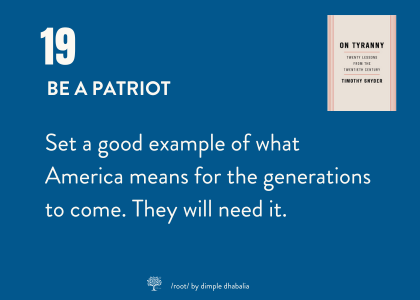
This essay is part of a 20-day project inspired by On Tyranny by Timothy Snyder.
A patriot must be concerned with the real world, which is the only place where his country can be loved and sustained.
- Timothy Snyder | On Tyranny | Lesson 19
A patriot is defined as someone who vigorously supports their country and is prepared to defend it against enemies or detractors. But what happens when the greatest threat to a country comes from within? When the loudest voices calling themselves patriots are, in fact, undermining the very values they claim to protect?
In a nation fractured by disinformation, historical amnesia, and a deep moral divide, it often feels like we’re living in two entirely different countries—and if I’m being honest—I think we always have been. From our inception, the promise of America was never envisioned for everyone. But I suppose it’s always like that in authoritarian countries. There’s a regime hell-bent on consolidating power and enforcing conformity and compliance—and then there’s the resistance. So whose country are we defending? Whose values are we upholding? And who gets to be considered a patriot?
My father loved this country. He initially came here to pursue his masters degree and then chose to move here permanently from India, bringing his new bride with him, hopeful about the American dream. He worked hard, created jobs, gave back to his community, and fully embraced the rituals of assimilation—Sunday night football, backyard barbecues, and cold Coors beer with friends. His patriotism was quiet, steady, and deeply rooted in care: for his family, for his community, and for the possibility of building something better. And yet, under the current regime, would he be seen as a patriot? Or simply as another immigrant to be feared, vilified, and scapegoated?
To understand patriotism, we have to first define what it is not. It’s not the storming of a nation’s capital in an attempt to overturn an election. It’s not creating a revisionist history claiming slavery helped enslaved people. It’s not the deliberate cruelty of separating children from their parents at the border, or the dehumanization of entire communities for political gain. It’s not the mocking of veterans, the targeting of civil servants, or the casual leaking of classified national security information in online chats—including to journalists. These actions are not patriotic. They’re dangerous, reckless, and profoundly un-American.
Patriotism isn’t blind allegiance to power. It’s moral courage. It’s accountability. It’s showing up for one another, especially when it’s inconvenient. Patriotism is grounded in collective values for the betterment of society—justice, equity, compassion—and must be expansive enough to include all people, not just those who fit a narrow mold of white, Christian, cishet nationalism. Because let’s be clear: what we are witnessing now isn’t patriotism—it’s a toxic strain of nationalism built on exclusion, fear, and white supremacy. And it’s being wielded to justify censorship, criminalization of dissent, and the erosion of democratic norms.
That’s why we need real patriots to stand up—those willing to defend not just a flag, but the soul of a nation that the flag represents. Those who understand that love of country means reckoning with its flaws, owning its history, and striving toward something better. Because what’s at stake isn’t just political—it’s moral. It’s the future of our communities, our planet, and our shared humanity. If patriotism is rooted in care, then now is the time to care more fiercely, more openly, and more courageously than ever before.
check out other essays in this series . . .