why potlucks have the power to topple empires
On Tyranny - Lesson 15
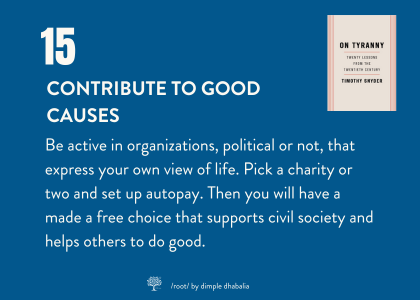
This essay is part of a 20-day project inspired by On Tyranny by Timothy Snyder.
Sharing is an undertaking that teaches us that we can trust people beyond our narrow circle of friends and family, and helps us to recognize authorities from whom we can learn.
- Timothy Snyder | On Tyranny | Lesson 15
Contributing to a good cause isn’t always about politics—it’s about human connection. While organized activism plays a role in resisting oppression, a more subtle and enduring power often lies in spaces of free association. Potlucks, book clubs, prayer circles, and casual gatherings—these are where trust is quietly formed.
In these moments, we start to break down barriers and truly see each other—not as strangers or adversaries, but as part of a shared community. Over time, these everyday acts of connection quietly strengthen the social fabric, teaching us to care for one another beyond family or immediate circles.
This is where democracy itself takes root. Free association is how we create civil society—it’s where we practice the skills of listening, empathy, compromise, and collective care. Without these informal, non-political spaces where people gather and build trust, democratic life withers.
Tyrants instinctively know this, which is why authoritarian regimes have always worked to suppress independent gatherings and claim control over communal spaces. They don’t just fear organized opposition—they fear the trust forged over shared meals, community projects, and informal networks, where relationships bloom outside the control of the state. These networks of trust, arising from shared meals, local projects, or mutual aid, form the quiet infrastructure of a thriving democracy.
It’s in these non-political spaces that we start to recognize who we can trust during times of uncertainty. These are the connections that guide who shows up when a neighbor faces deportation, when a colleague is arrested as a “threat to foreign policy,” or when a community is under threat. The more we engage in these spaces, the more we weaken the isolation that authoritarianism feeds upon. Over time, these small, repeated acts of showing up for one another create a resilient, interwoven community capable of withstanding and resisting tyranny.
Ultimately, it’s through free association that we create the conditions for democracy to flourish—not just in formal institutions, but in the shared experiences and everyday choices that define civil society. The most powerful resistance often begins around dinner tables, at community events, or while working side-by-side on projects that make us feel good. In gathering freely, we build not only trust and care, but the very foundation upon which democratic life depends.
check out other essays in this series . . .