the hook and the net
On Tyranny - Lesson 14
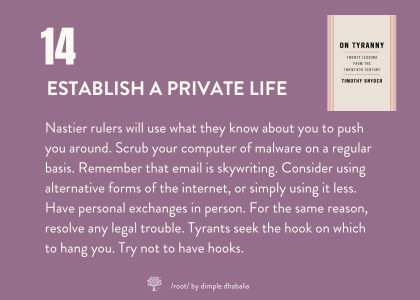
This essay is part of a 20-day project inspired by On Tyranny by Timothy Snyder.
If we have no control over who reads what or when, we have no ability to act in the present or plan for the future.
- Timothy Snyder | On Tyranny | Lesson 14
Many years ago, I worked on a privacy and data project with colleagues from the European Union. I remember that many of the challenges we faced stemmed from the gap between data privacy laws in the U.S. (which were virtually nonexistent) and the robust framework of policies and regulations in the EU. As I think about it now, I realize part of this was because Europe had lived through the Holocaust. They understood firsthand that tyrants have always sought leverage over those who might resist them—the hook on which to hang you—as described by Timothy Snyder.
In today’s surveillance-driven society, that hook is forged from personal data—information we willingly and unwillingly give away in the digital sphere. Whether it’s the information we share on social media or the little form we fill out to get a tag at the grocery store for discounts and “points,” the erosion of our privacy has happened on many levels over the years. It isn’t just an individual risk but a political one, deeply entangled with capitalism and consumerism.
Hannah Arendt warned that society's "appetite for the secret" feeds the dangerous machinery of authoritarianism. When we become obsessed with the private lives of others—celebrities, politicians, even neighbors—we open the door for power-hungry leaders to weaponize personal histories, mistakes, and relationships to isolate, shame, and control. In this landscape, resisting tyranny begins with safeguarding both personal boundaries and collective freedoms.
At the individual level, protecting our privacy is a form of resistance and self-preservation. Scrubbing our devices of malware, limiting what we share online, and engaging in direct, in-person conversations removes potential hooks that can be used against us. While it can feel like self-censorship or paranoia, it has become a grim necessity in a world where the line between a free society and fascism is threadbare.
But this vigilance about our privacy doesn’t just apply to us as individuals—it creates responsibilities for the collective. As a society, we have a responsibility to protect those at the forefront of justice—journalists, activists, whistleblowers, and human rights defenders—who are increasingly targeted by regimes eager to silence them. When we fail to stand in solidarity, we create fertile ground for authoritarianism to thrive, using fear and manipulation to fracture communities and weaken resistance.
Technology has made this dual challenge more complex. On one hand, it connects us across borders, offering tools for organizing, mutual aid, and amplifying marginalized voices. On the other, we are tangled in a net of platforms hijacked by greed—algorithms that reward outrage, breed competition, and fuel conspiracy theories.
These unchecked systems, designed to maximize engagement and profit, have also become playgrounds for disinformation and state-sponsored propaganda. Our addiction to digital platforms leaves us vulnerable to manipulation—not just from tyrants, but from the mechanisms of the platforms themselves.
To defend democracy and human rights, we have to learn to navigate this double-edged sword with care. This means cultivating media literacy, practicing digital hygiene, and building communities rooted in trust and in-person relationships. It also means advocating for stronger protections and transparency from tech companies who profit off the erosion of our private lives.
Tyrants bait the hook, tyrants cast the net—but we can choose not to bite.
check out other essays in this series . . .