where truth ends, tyranny begins
On Tyranny - Lesson 10
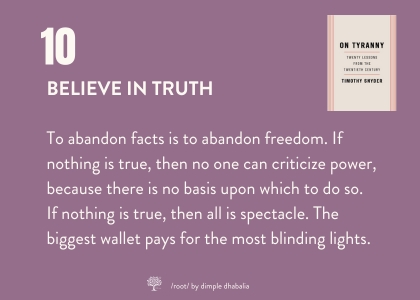
This essay is part of a 20-day project inspired by On Tyranny by Timothy Snyder.
You submit to tyranny when you renounce the difference between what you want to hear and what is actually the case.
- Timothy Snyder | On Tyranny | Lesson 10
The erosion of truth is the first crack in the foundation of any free society. Timothy Snyder’s warning—that to abandon facts is to abandon freedom—echoes louder today than ever before. We live in an era where oligarchs aren’t just amassing wealth—they’re purchasing influence over the stories we’re told about the world.
When Jeff Bezos acquired The Washington Post, many clung to the hope that journalism could remain independent under corporate stewardship. Yet, Bezos’ recent decision to only publish opinion pieces about “personal liberties and free markets” and not publish opposing viewpoints on those topics points to a dangerous shift: a narrowing of the public discourse.
The biggest wallet really does pay for the brightest, most blinding lights. And now, with 47 and his regime tightening their grip on the levers of power, we’re seeing the machinery of the state being used to intimidate, silence, and manipulate on an unprecedented scale. When the spotlight is on what they want us to see, what is left in the shadows?
The silencing of truth is no longer just a matter of corporate influence or partisan politicking—it’s state-sponsored and deliberate. Under 47’s leadership, the regime is slashing funding for libraries, targeting them as "woke indoctrination centers" instead of sanctuaries of free thought. Universities, particularly those that support critical race theory, gender studies, or climate science, are increasingly defunded or subjected to direct state interference. Scholars are losing their jobs, curricula are being gutted, and public education is under siege. And those who use their voice to call out injustice risk being made an example.
This isn’t just a cultural battle—it is a calculated move to eliminate the spaces where critical thinking and dissent are nurtured. This tactic has echoes in Rwanda, where media outlets like Radio Télévision Libre des Mille Collines were weaponized to spread lies, dehumanize the Tutsi population, and mobilize the Hutu into committing genocide. Control the narrative, control the people. We’re watching that blueprint being rewritten in real time for the digital age.
But I remember another version of America—the one I experienced as a freshman in college. During my second semester, I was required to take an Intro to the Bible course. I walked into that class with every intention of disengaging. As a Hindu student, I assumed the class would preach narrow Christian values that conflicted with my own. My plan was simple: check the requirement off my list and move on. But then something curious happened.
The professor didn’t demand conformity—he invited inquiry. He modeled critical thinking, challenged my assumptions with curiosity, and created a space where debate was welcomed, not feared. Slowly, my rigid preconceptions gave way to nuance and understanding. In that classroom, I discovered that truth-seeking isn’t about indoctrination, but about exploring complexity. It was a reminder that within each of us exists a form of humanity that transcends any particular religion, holy book, or god to whom we pray.
In the U.S. right now, the manipulation of the masses is turbocharged by oligarchs aligned with 47’s regime, who are buying media outlets, amplifying propaganda, and crushing independent journalism under the weight of algorithmic suppression and state intimidation. The regime’s open hostility to facts isn’t an accident—it’s a strategy.
When laws are passed forbidding entire topics of discussion in classrooms, when public employees are fired for acknowledging systemic racism or LGBTQ+ rights, when federal agencies are pressured to falsify scientific data or suppress reports, the line between reality and spectacle vanishes. Snyder’s warning becomes a grim prophecy: when we submit to the comfort of hearing what we want instead of confronting reality, we give tyranny the fertile ground it needs to thrive.
Perhaps what’s most chilling is how rapidly this collapse is happening. Democracies require informed citizens capable of engaging in reasoned debate and holding power to account. But 47’s regime thrives on misinformation, weaponized nostalgia, and grievance politics. Like Rwanda, Cambodia, or Pinochet’s Chile, and the current genocide in Gaza, history is full of examples where the people with power manufacture alternate realities to justify oppression, violence, and control. The U.S., with its growing economic inequality and systematic dismantling of intellectual freedom, stands on that same precipice.
But what if we dared to imagine a different system—one rooted in mutual aid and collective care instead of spectacle, silencing, and state-sponsored lies? A society where power is decentralized, where libraries and universities are bastions of truth and critical thinking again, where the pursuit of knowledge is seen as an act of communal resilience.
Remember, collapse isn’t inevitable—it’s a choice.
Will we continue to let the regime and its benefactors buy and bury the truth? Or will we reclaim it, grounded in facts, collective care, and a shared commitment to freedom?
check out other essays in this series . . .