margins of defiance
On Tyranny - Lesson 13
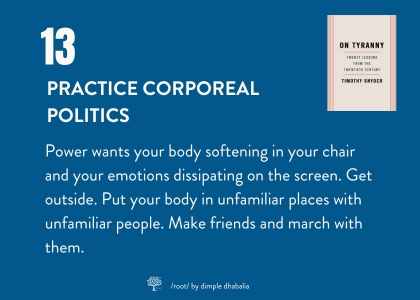
This essay is part of a 20-day project inspired by On Tyranny by Timothy Snyder.
We are free only when it is we ourselves who draw the line between when we are seen and when we are not seen.
- Timothy Snyder | On Tyranny | Lesson 13
In On Tyranny lesson 13, Timothy Snyder talks about practicing corporeal politics, noting that nothing is real unless it ends in the streets. As I read and reread this short lesson, I realized it didn’t sit well with me. Snyder’s framing risks reflecting the privilege of someone whose body is less policed, without fully considering that for many communities—especially BIPOC, LGBTQ+, and other historically oppressed groups—the streets are often fatal and not the only place where the fight for rehumanization, collective liberation, and change takes root.
As an artist and writer, I view creativity as both a personal and political practice. My work has always been rooted in storytelling as a way to shed light on humanity and bridge gaps. In moments like these—as dehumanizing systems tighten their grip and authoritarianism shifts from looming threat to active reality—I find myself asking: how can my art become a living force against oppression? How can I physically and emotionally place myself and my work into spaces where rights are being stripped away and our humanity is being erased? Art is how I, and so many others, choose to practice corporeal politics.
Throughout history, authoritarian regimes have feared artists and their work because art interrupts, exposes, and mobilizes. From Nazi book burnings to the censorship of artists under apartheid, during the Cold War, and throughout the Civil Rights Movement, authoritarian regimes have long feared and repressed art that challenges power. Creativity has always been—and remains—the enemy of regimes that demand silence and uniformity.
Today, we’re watching these patterns repeat under 47’s regime. His recent illegal executive order seeking control over museums and libraries isn’t just bureaucratic overreach—it’s a deliberate attempt to sever our collective access to memory, creativity, and critical thinking. These cultural institutions house the voices of the past and present that fuel resistance for a better future, making them natural targets for authoritarian control.
Art’s role in resistance movements has never been solely about preservation—it’s about activation. As bell hooks showed us in her work, it is in the margins where we find spaces of radical possibility, where historically oppressed people have used creativity to help their communities survive and dream new worlds into being. For Black women, queer artists, and other oppressed communities, art has long been a form of corporeal politics—a way to create visibility, build community, and reclaim agency. James Baldwin understood this power, writing, "Artists are here to disturb the peace." This disruption is what makes art dangerous to tyrants; it awakens our imagination and reminds us we are not alone in our longing for justice. Yet, despite the danger, artists have courageously used art to occupy public space and demand to be seen and heard on their own terms.
Art has the capacity to be both a call to action and a gathering place. We’ve seen it in protest murals after the murder of George Floyd, in the resistance zines circulated during the civil rights movement, and in the defiant literature of exiled writers across the globe. Art holds memory, grief, rage, and hope. It broadens our perspectives and inspires us to step beyond the screen and onto the streets, to form connections that transcend borders and oppressive systems.
In this way, art isn’t a substitute for corporeal politics—it is corporeal politics. It forces us to gather, to confront, to mourn, to dream—together. Whether in galleries, public squares, grassroots publications, or performance spaces, art calls people into the shared labor of resistance. Even now, under surveillance and repression, artists are finding ways to make the invisible visible and to remind us that collective liberation can’t just imagined—it must be lived. By practicing corporeal politics through art, we choose visibility on our own terms, and in doing so, we defy the forces that seek to silence us—both in public spaces and in the margins.
check out other essays in this series . . .