trust is built in the mundane moments—not the extraordinary
On Tyranny - Lesson 12
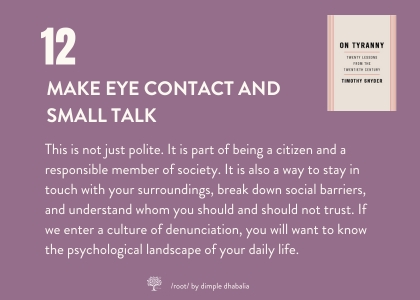
This essay is part of a 20-day project inspired by On Tyranny by Timothy Snyder.
In the most dangerous of times, those who escape and survive generally know people whom they can trust.
- Timothy Snyder | On Tyranny | Lesson 12
The idea of making small talk with people sounds deceptively simple. We tend to think of politeness and casual conversation as social niceties, but in truth, they are foundational to how we build and sustain empathy, and build trust.
Under 47’s regime, where division is both a tactic and a goal, these small moments of connection have taken on the weight of quiet acts of resistance. The language being used by those in power—words like “invasion,” “infestation,” “illegals,” or “vermin”—is calculated to strip away the humanity of entire groups of people. When language turns people into threats, it becomes easier for neighbors to look past one another in silence, to stop seeing, and to start fearing.
I’ve written before about how language shapes our world, but what we’re living through now under 47 is beyond rhetoric—it is a deliberate campaign to sever the fragile threads of empathy that hold a society together. When people stop questioning what they’re being told and accept these dehumanizing narratives at face value, it becomes a lot easier to look the other way as individuals are stripped of their rights and their humanity.
It shows up in the small, everyday ways people pull back: the averted gaze, the hurried step past someone who looks or sounds “different,” the silence in a room where there should be solidarity. This fear, cultivated by those who thrive on division, is robbing us of our ability to see each other as fully human.
That’s why taking a minute to acknowledge the people around us is more than just kindness—it’s a refusal to allow ourselves to become disconnected from our own humanity and the humanity of those around us. Trust is built in the mundane moments more often than the extraordinary. These gestures aren’t insignificant; they’re how we signal to one another, “I see you. I stand with you. You matter.”
In times like these, it’s important to find subtle but clear ways to let people know you are an ally. A conversation at the bus stop, a greeting in the hallway, a shared laugh in the checkout line—these are seeds planted now that may become lifelines later. You can’t trust what you don’t know. Establishing trust and building relationships when times are relatively stable means that when things inevitably get worse, you already know who your community is. And equally important, they know you.
47’s regime is counting on fear to fray our social fabric. But we can make another choice. We can choose to be present, to connect, to extend empathy through the smallest of actions. And in doing so, we remind each other—and ourselves—that community and humanity are always within reach, no matter how loud the machinery of division becomes.
check out other essays in this series . . .