how their lies become our truth
On Tyranny - Lesson 11
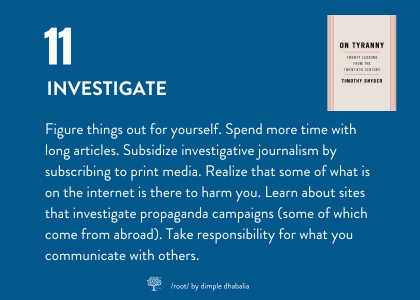
This essay is part of a 20-day project inspired by On Tyranny by Timothy Snyder.
We do not see the minds that we hurt when we publish falsehoods, but that does not mean we do no harm.
- Timothy Snyder | On Tyranny | Lesson 11
Investigating the truth in today’s world requires stamina, intention, and a willingness to confront our own biases. The democratization of media—through platforms like Substack, podcasts, and social media—has been both a gift and a curse. It’s created space for voices historically excluded from traditional media and allowed marginalized communities to share their stories without corporate filters or gatekeepers. Yet, it has also opened the floodgates for unchecked information, where anyone can claim expertise and opinions often masquerade as facts. The collapse of traditional fact-checking and multi-source confirmation in journalism has left a void, where headlines are crafted for clicks and algorithms reward outrage, making it harder to find depth or context beneath the surface noise.
This is where confirmation bias creeps in. Our human tendency to seek out information that validates what we already believe is amplified in a digital landscape designed to keep us scrolling. Acting with intention means fighting that impulse, digging deeper, and confronting uncomfortable truths. It means understanding that real facts—verifiable, objective facts—are supposed to be irrefutable. Yet here we are, under a regime where blatant lies are repeated until catchy soundbites based on a single narrative become “truth” for millions. We’ve all watched 47 stand at a podium and claim things we can definitively prove false, and yet millions will nod along. That’s not just gaslighting; it’s a systematic campaign to redefine reality.
Of course, this isn't new. This country has been twisting facts for centuries to suit its dominant narrative. Our history books were filled with “facts” about how this land was “settled” by brave men and women, a fact repeated so often that the theft, genocide, and forced removal of Indigenous people were reduced to mere footnotes, if they were mentioned at all. We were conditioned to believe in an American exceptionalism that paints a picture of grit and perseverance, encouraging everyone to “pull themselves up by their bootstraps” without ever acknowledging how Indigenous people, the descendants of enslaved Africans, immigrants, and others were—and still are—forced to navigate a rigged system. The official narrative conveniently leaves out the policies and violence that kept Black Wall Street from flourishing or that funneled Latino and immigrant labor into low-wage jobs—policies, violence, and economic sabotage that have kept entire communities from advancing while elevating myths of rugged individualism.
The government, corporations, and media have worked hand in hand to reinforce these half-truths. Headlines labeling Black youth as “thugs,” or depicting immigrants as “burdens,” subtly support the lie, while rarely acknowledging state-sanctioned oppression or community resilience. These carefully curated narratives rely on selective “facts,” shaped to justify inequality and preserve power. Over time, these distortions seep into public consciousness until they feel like common sense. And then, when confronted with actual facts—about stolen land, about state violence, about economic inequity—they feel somehow less believable, more like conspiracy theories, because they don’t match the version of history we’ve been fed for so long.
Investigating, then, is an act of resistance. It’s refusing to passively absorb what’s placed before us and instead choosing to peel back the layers and see things as they are. It’s reading beyond the slanted headlines, interrogating the word choices, and refusing to accept information at face value—whether it comes from a legacy news outlet or a viral post on social media. It means refusing to normalize harmful rhetoric and distorted realities. In this moment, we have a responsibility not just to consume information, but to question the structures that produce it, and to actively seek out the truth beneath what we see on the surface.
check out other essays in this series . . .