reclaiming our words, reclaiming ourselves
On Tyranny - Lesson 9
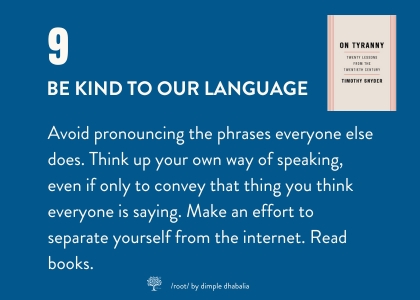
This essay is part of a 20-day project inspired by On Tyranny by Timothy Snyder.
The effort to define the shape and significance of events requires words and concepts that elude us when we are entranced by visual stimuli.
- Timothy Snyder | On Tyranny | Lesson 9
The slow erasure begins with language. When I recently read the list of words the regime is prohibiting federal government agencies to use—Black, women, Indigenous, LGBTQ+, trans—I felt it as a kind of gut punch, familiar and sharp. Erasing words erases people. To forbid language is to insist we don’t exist.
We’ve been gaslit from the beginning through calculated phrasing embedded in the founding documents of this country. “We the People” never meant all of us. It meant white, property-owning men. Black people were fractions, women were invisible, Indigenous nations were obstacles to be overthrown.
The legacy of those omissions lives on in the rhetoric we hear today, as 47 labels immigrants “aliens,” speaks of “shithole countries,” and reduces people to “DEI hires”—catchphrases that seep into the vocabulary of even those who oppose his horrific language. The weaponization of DEI further reveals how quickly a concept rooted in equity and justice can be turned into a slur, exposing how words, when used without intention or action, are often hollow from the beginning—buzzwords serving as little more than corporate and governmental talking points, while the practices underneath often contradict the language. So-called inclusive words continue to mask systemic harm, creating an illusion of progress while oppression remains deeply rooted in our culture.
In Fahrenheit 451 and 1984, Bradbury and Orwell warned us about how the state-controlled “interactive TVs” numb the population, creating the illusion of participation without genuine engagement. Today, we see this in the form of social media—our feeds scroll endlessly, distracting us while the erosion of rights and identities accelerates just beyond the frame.
What strikes me is how much of the dominant narrative around resisting tyranny still comes from a singular, often white, perspective. We quote Orwell and Bradbury, and Snyder even refers to noted transphobe JK Rowling in On Tyranny, but what about the wisdom from those who’ve long lived under the boot of systemic oppression? What about Parable of the Sower in which Octavia Butler, with her prescient storytelling, foresaw much of the dystopia we now find ourselves in—where authoritarianism, environmental collapse, and societal division intertwine. What about the stories of Black women, Indigenous elders, queer thinkers, immigrant scholars?
These are the voices that expand the conversation from survival to transformation.
Writers like bell hooks, Audre Lorde, Robin Wall Kimmerer, Tricia Hersey, Viet Thanh Nguyen, Valerie Kaur, John a. Powell, and others don’t just critique oppression—they offer us pathways toward wholeness. They remind us to embrace rest as resistance, find solace in community as sanctuary, and rely on the natural world and ancestral wisdom for guidance.
When I engage with their work, I feel myself breaking free from the web of fear 47 and his regime are spinning, desperate to trap us in a hell of their making. What if instead of parroting back 47’s dehumanizing phrases, we expanded our language—through books, articles, and poetr—to include voices, words, and concepts like spiritual ecology, collective care, moral courage, interdependence, and bridging, creating new pathways toward liberating ourselves from tyranny? To remind us that we’re not alone, and that history moves in cycles. That there is power in seasons, in grief and renewal, in finding each other in the dark. Reading these voices feels like gathering around a communal fire, where we share not only stories of harm but also of resilience, and care, and love—where we remember that healing is possible, together.
Our words shape how we speak, and how we speak shapes the world we create. When we resist the flattening of language and root ourselves in the deep, complex truths of diverse histories, we reclaim not just our words, but our humanity.
check out other essays in this series . . .
 Dimple Dhabalia