whether to enforce tyranny or uphold justice is always a choice
On Tyranny - Lesson 7
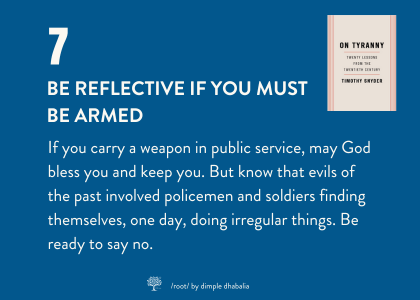
This essay is part of a 20-day project inspired by On Tyranny by Timothy Snyder.
But without the conformists, the great atrocities would have been impossible.
- Timothy Snyder | On Tyranny | Lesson 7
Throughout history and around the world, armed agents of the state—police officers, soldiers, and secret security forces—have played a decisive role in enforcing tyranny. It’s been no different here in the United States. From the Jim Crow South to the forced sterilization of marginalized communities, from the brutal repression of student protests to the unchecked violence against Black and brown communities, those entrusted with protecting the oppressed have too often become tools of the oppressor. Timothy Snyder’s warning in lesson 7 of On Tyranny—“Be reflective if you must be armed”—is not just a historical lesson. It is a command for the present moment.
Recent images of riot police in full tactical gear tear-gassing and arresting university students protesting the genocide in Gaza feel eerily familiar. They echo the black-and-white photographs of the 1960s—police dogs unleashed on children, billy clubs used on lunch counter protesters, tear gas filling the streets as students in Selma and Memphis demanded dignity and basic human rights. They evoke the grainy footage of police officers beating Rodney King and from Kent State in 1970, where National Guardsmen fired 67 rounds into a crowd of unarmed students, killing four. And they remind us of the knee pressed into George Floyd’s neck, the bullets that ended Breonna Taylor’s life, and the countless others killed by those who were supposed to serve and protect.
Despite the narrative that white supremacy in America has shaped for generations, these moments aren’t one-off situations—they’re stark reminders that elements of fascism have long existed in the United States, embedded in the institutions that are charged with safeguarding democracy.
There are of course many law enforcment officials who operate with integrity and compassion. However, history tells us that despite their best intentions, when the moment comes, the people tasked with enforcing the law often become the enforcers of injustice. It was law enforcement that upheld the racial terror of sundown towns, ensuring that Black families knew they could not safely exist in certain places after dark. It was officers in neatly pressed uniforms who facilitated mass internment, rounding up Japanese Americans and sending them to desolate camps, stripping them of their dignity and citizenship. It was the police who turned a blind eye—or an active hand—to lynchings, ensuring that no white man would ever face justice for a Black man’s murder.
As humans, our power lies in our agency to choose. That is the lesson of history. Every soldier, every officer, every person who carries a weapon in their official capacity will, at some point, be asked to uphold not justice but power. To stand silent or to act. To harm or to protect. The ones who say no—the ones who refuse to brutalize their own people—are the ones who history remembers with honor.
In a world where fascist principles are being brought out of the shadows and into the open under the current regime—where laws criminalize dissent and where militarized police are dispatched not to protect but to intimidate—the question remains: Will those who carry weapons in the line of duty reflect on their responsibility, or will they, too, find themselves doing “irregular things”?
check out other essays in this series . . .
 Dimple Dhabalia
 Dimple Dhabalia
 Dimple Dhabalia