the face of the world is changing. are we paying attention?
On Tyranny - Lesson 4
This essay is part of a 20-day project inspired by On Tyranny by Timothy Snyder.
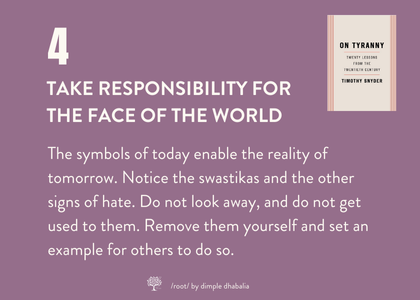
You might one day be offered the opportunity to display symbols of loyalty. Make sure that such symbols include your fellow citizens rather than exclude them.
- Timothy Snyder | On Tyranny | Lesson 4
Timothy Snyder warns us that authoritarianism doesn’t descend overnight; it seeps in through the images, words, and small gestures that begin to shape the world around us. Lesson 4, Take Responsibility for the Face of the World, reminds us that what we normalize through propaganda, symbols, and public displays of loyalty is what ultimately takes hold in society.
Walking down the street today, turning on the news, or scrolling through social media, it’s impossible to ignore the ways our public spaces have shifted since 2016. When he was 45 we vowed “never again,” and yet, here we are, face-to-face with the wrath of 47. Since 2016 we’ve seen his name is emblazoned on banners draped over highway overpasses, and men wrapped in American flags salute him like a king at his rallies. The language of violence—about “cleansing” the country, “retribution” against his enemies, and “final battles”—isn’t just spoken but plastered on t-shirts, hats, and even children’s clothing. Make no mistake—these aren’t just expressions of political enthusiasm—they are declarations of allegiance to a leader over democracy itself.
History has shown us where this road leads.
Most of us would like to believe we would have resisted the rise of fascism in Germany, the brutal regime in Pinochet’s Chile, or the racial terror of apartheid South Africa. But the real test is not what we think we would have done—it’s what we are willing to do now. If history is any guide, propaganda doesn’t just inform people—it conditions them. The constant repetition of lies—about immigrants, about elections, about who deserves to belong—wears down even those who know better.
Suddenly, phrases that once would have sent chills down our spine become slogans shouted in unison at rallies. The mass deportation of families or individuals exercising their Constitutional rights are rebranded as “law and order.” Calls to imprison political opponents are dismissed as mere rhetoric. The shift is subtle but dangerous, and it’s happening in real-time.
So what does it mean to take responsibility for the face of the world?
It means resisting the temptation to look away. It means refusing to let symbols of oppression become just another part of the landscape. It means speaking up when we see neighbors, colleagues, and even friends parroting dangerous narratives. It means making our own values visible—through the stories we tell, the art we create, the conversations we refuse to avoid. It means remembering that failing to push back against encroaching tyranny and participating in its spread are two sides of the same coin.
The question isn’t whether we’ll be put in the position others once were. We already are. The face of the world is changing, and the only question left is whether we will let it change without a fight.
check out other essays in this series . . .
 Dimple Dhabalia
 Dimple Dhabalia
 Dimple Dhabalia