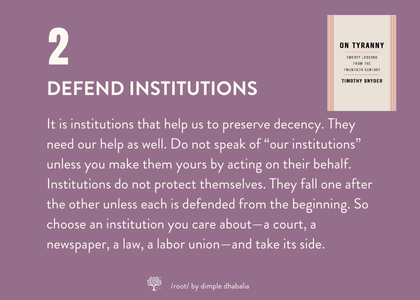
eternal vigilance is the price of liberty
On Tyranny - Lesson 3
This essay is part of a 20-day project inspired by On Tyranny by Timothy Snyder.
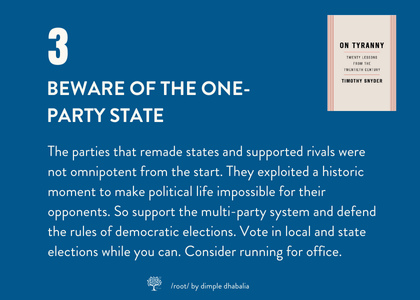
The mistake is to assume that rulers who come to power through institutions cannot change or destroy those very institutions—even when that is exactly what they have announced they will do.
- Timothy Snyder | On Tyranny
Democracy rarely collapses in a single dramatic moment. More often, it is chipped away piece by piece until the structure still stands, but the foundation is hollow. Here in the United States, we have been lulled into a false sense of security—a belief that democracy is a fixed state, that our checks and balances will always hold, and that free and fair elections will endure.
But history tells a different story.
Germans in 1932, Czechs in 1946, Brazilians in 1960, Russians in 1990, Venezuelans in 1998, Turks in 2002—the list goes on. It’s unlikely that citizens of any of these countries cast their ballots thinking it would be their last real chance to do so for a long time. Unlikely that they imagined, in that moment, that they were voting their way into authoritarianism. The parties that remade these states and silenced opposition didn’t come to power with unchecked authority; they exploited moments of crisis to make political life impossible for their rivals. Piece by piece, they unraveled their democratic systems. They rewrote the rules, stacked the courts, discredited the press, and turned elections into empty rituals rather than true expressions of the people’s will.
And now, we are witnessing the same patterns unfold in the United States today.
American abolitionist Wendell Phillips warned that “eternal vigilance is the price of liberty.” The hard truth is that democracy requires constant defense—not just against foreign adversaries, but against oligarchs, and who see its openness as a weakness to be manipulated. In just under seven weeks of 47’s regime, we have seen retribution against political opponents, the dehumanization of immigrants, the dismantling of institutions, illegal detentions, and a flagrant disregard for the rights enumerated in the Constitution.
This is how democracies fall—not with a single, dramatic event, but through the calculated erosion of institutions until the foundation is too weak to hold. It would be a mistake to believe that democracy will simply correct itself through midterm elections or the impeachment process. The warnings are clear: if we allow one party to consolidate control by suppressing opposition, democracy in America may not recover in our lifetime.
The defense of our country, our institutions, and our Constitution begins with action. Supporting a multi-party system. Safeguarding election integrity. Voting in local and state races while we still can. And if you can, run for office. History is clear—those who wait for democracy to correct itself often find that by the time they recognize the danger, the choice has already been made for them.
check out other essays in this series . . .
 Dimple Dhabalia
 Dimple Dhabalia