the slippery slope to complicity
On Tyranny - Lesson 5
This essay is part of a 20-day project inspired by On Tyranny by Timothy Snyder.
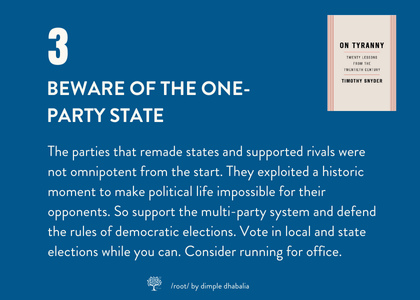
Professional ethics must guide us precisely when we are told that the situation is exceptional. Then there is no such thing as “just following orders.”
- Timothy Snyder | On Tyranny | Lesson 5
For years, part of my job involved interviewing refugees and asylum seekers, ensuring that those seeking protection in the United States had not, in turn, persecuted others. Regardless of the country from where people were coming, or the job or title they had in their country of claimed persecution, when we identified that they belonged to a group—the military, a militia, a government, or a professional role—associated with mass atrocities in their country, the claimed defense was often the same: I was just following orders. In those moments, my stomach would churn as I bore witness to the chilling fact that persecution, oppression, and tyranny—whatever you call it—do not function without willing participants.
Perpetrators of violence and oppression are rarely born as such; they’re molded by systems that incentivize obedience and erode professional ethics under the guise of necessity. When I served in the government, the expectation was that, as a civil servant, I would abide by a set of ethics and uphold the principles of justice even if ignoring them would benefit me in some way. Yet today, those very same laws meant to protect the American people have been twisted and weaponized, their original intent dismissed by those who seek unfettered power and control.
For example, in Nazi Germany, the judiciary played a crucial role in enabling the Holocaust. Rather than creating accountability for those in power, judges and legal professionals set aside their ethics, choosing to serve the regime instead of the rule of law. They legitimized the persecution of Jewish people, Jehovah’s Witnesses, the Roma, LGBTQ+ individuals, people with disabilities, and other marginalized groups, enforcing racial purity laws, rubber-stamping state-sponsored violence, and ensuring that Nazi policies had the appearance of legality. Their willingness to comply helped create the legal infrastructure necessary for genocide. History has shown us that when professional ethics are abandoned in favor of obedience, the consequences are devastating. We would like to believe we are immune to such failures, but history repeats itself when we refuse to learn from it.
Today, we’re witnessing the United States follow an eerily similar path, where members of all three branches of government have seemingly abandoned their ethics to support the delusional ambitions of one man. Judges issue rulings that undermine democratic norms. Legislators either look the other way or actively help as institutions are dismantled. Executive officials once tasked with defending the Constitution now justify authoritarian overreach in the name of national security. Even people who believe they would never engage in the persecution of others find themselves staying silent. It begs the question: When fear, threats, and political pressure come into play, how do they warp ethical judgment?
The laws and values that civil servants and the military dedicated their lives to protecting are now being flagrantly violated by those who swore to defend them. Political leaders set the tone, and when that tone is one of disregard for human rights, fear becomes a tool to manipulate the very people tasked with enforcing justice. Threats, fear tactics, and shifting political winds create an environment where moral clarity is clouded, where the rules we once followed seem suddenly malleable. It’s in these moments—when we are told that the situation is exceptional and that the stakes are too high to cling to ethics—that professional integrity is most critical.
There is no such thing as “just following orders.” We have seen what happens when professionals—judges, lawyers, civil servants, medical professionals, and others—abdicate their moral responsibilities in favor of self-preservation. It’s how authoritarian regimes take hold. It’s how laws meant to protect the collective become tools of individual oppression. If we allow fear to dictate our ethical choices, we risk becoming the very thing we once sought to prevent. Professional ethics are not meant for moments of ease, but for moments of crisis. When we abandon them, we don’t just fail ourselves—we fail democracy itself.
check out other essays in this series . . .
 Dimple Dhabalia
 Dimple Dhabalia
 Dimple Dhabalia