anticipatory obedience is a human tragedy
On Tyranny - Lesson 1
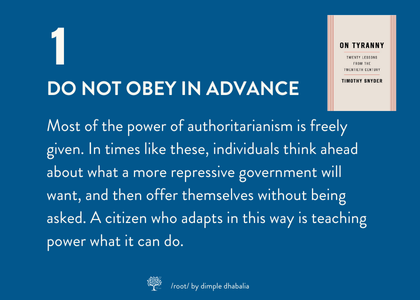
This essay is part of a 20-day project inspired by On Tyranny by Timothy Snyder.
Anticipatory obedience is a political tragedy.
- Timothy Snyder | On Tyranny
I believe anticipatory obedience is actually a human tragedy.
We’re watching in real time as individuals—some out of fear, others out of exhaustion—acquiesce to the whims of 47 and his henchmen who are eroding democracy, dignity, and truth in the quest for total domination. The steady normalization of dehumanization, corruption, and chaos has conditioned many to feel that resistance is futile, that speaking up will only invite backlash, and that silence is the safest option.
But history, and our own lived experiences, tell us otherwise.
We are at an inflection point where obedience to injustice masquerades as pragmatism. As the regime throws spaghetti at the wall to see what sticks, we see leaders choose "civility" over accountability, journalists platform extremist views under the guise of "balance," and colleges, universities, and other institutions allow themselves to be bullied into submission rather than standing firm in their principles. Each time they capitulate, the regime is emboldened.
The thing is, obedience in advance isn’t just a political failing; it’s a deeply personal one, too. How often do we, as individuals, hesitate to call out harm, to challenge a false narrative, to reject an unfair rule—not because we believe it’s right, but because we’ve convinced ourselves that pushing back won’t matter, or simply because we’re scared? This is how oppression tightens its grip—not with a single authoritarian decree, but with a thousand small surrenders.
During my years of interviewing asylum seekers and refugees, I was always in awe of people who fought for freedom and were willing to die for their cause. I used to wonder: if I were ever in a similar situation, would I be willing to give up my life for an ideal? Even now, as we stand on the edge of dictatorship in America, I don’t know if I would be willing to sacrifice my life for an ideal—a fact that fills me with shame.
That said, we’re not there yet, and I’m not willing to obey in advance. The opposite of quiet complicity is conscious defiance—a refusal to play along with the script that those in power expect us to follow. It’s choosing to speak the truth even when it’s inconvenient or dangerous, to protect those who are vulnerable even when it’s unpopular, and to hold firm to our values even when the cost feels high.
America has muddled our way through dark chapters—slavery, the genocide of Native Americans, Jim Crow, Japanese internment, the Iraq War, George Floyd, and so many others. But through each, there was an underlying belief that our institutions were stronger than any one person. This time feels different.
Resistance isn’t always loud or flashy. Sometimes, it’s as simple as asking a difficult question in a room where no one else will or refusing to let a lie go unchallenged. The choice to not obey in advance is one we make every day, in moments both big and small. And in those choices, we reclaim our agency—and, perhaps, our future.