our moral responsibility for righteous resistance
On Tyranny - Lesson 8
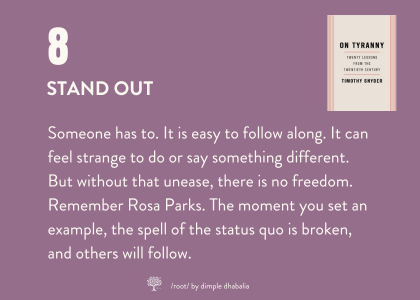
This essay is part of a 20-day project inspired by On Tyranny by Timothy Snyder.
It is those who were considered exceptional, eccentric, or even insane in their own time—those who did not change when the world around them did—whom we remember and admire today.
- Timothy Snyder | On Tyranny | Lesson 8
Taking a stand against injustice instead of simply following the masses is rarely the easy choice. It means stepping outside the comfort of the crowd, drawing attention to yourself, and risking the consequences of doing something different. To stand out is to disrupt the unspoken rules that keep things as they are, even when those rules are unjust. It’s why societies often resist change, punishing those who challenge the status quo. But history has shown that progress has never come because people stayed silent. The people we now celebrate—Rosa Parks, Mahatma Gandhi, Nelson Mandela—were once seen as agitators, troublemakers, threats. They chose to engage in righteous resistance, not because it was safe, but because they understood that silence would mean surrendering to oppression.
Righteous resistance is more than just defiance; it is the moral act of standing against injustice, even when the costs of doing so are high. In the past, this meant abolitionists risking their lives to end slavery, suffragists demanding the right to vote, and civil rights activists marching in the face of violence. It meant underground networks protecting Jewish families during the Holocaust or citizens in authoritarian states smuggling out the truth.
Today, righteous resistance takes new forms. It’s workers organizing against exploitative corporations, journalists exposing corruption, and activists demanding justice in the streets. It is people refusing to comply with systems that dehumanize, whether through boycotts, whistleblowing, or acts of civil disobedience. What was once done in secret—passing pamphlets, broadcasting messages over shortwave radio—is now amplified through social media, reaching millions in an instant. But the fundamental challenge of righteous resistance hasn’t changed: standing up and standing out still means accepting the risks that come with it.
It’s no accident that we’re witnessing the erosion of democratic norms once again. Before World War II, several European nations, from Italy to Germany to Spain, willingly surrendered democracy to strongmen promising stability, prosperity, and a return to a mythologized past. The playbook remains the same. Fear is stoked. The “other” is blamed. Rights are stripped away under the guise of national security. We have seen this before, and yet, too many still believe that this time is different. But history has a way of repeating itself when people choose complacency over courage.
Authoritarian regimes don’t simply want obedience; they want unquestioning allegiance. Dissent becomes dangerous, and righteous resistance, once an act of personal conviction, turns into an act of rebellion. In 1930s Germany, refusing to salute, speaking out against Nazi policies, or protecting Jewish neighbors could mean death. Today, resistance may not always come with the same mortal consequences, but the costs are still steep. The current regime doesn’t need gulags when it has legal status revocation, financial ruin, and digital erasure at its disposal. And yet, people still find the moral courage to resist. They boycott, they march, the write, they disrupt.
Because someone has to.
Hitler envisioned a post-war world divided into spheres of influence, where the powerful carved up the globe like a chessboard. Colonization, of course, had already done much of that work. Africa, the Middle East, and parts of Asia had been claimed and controlled by European empires for centuries, their resources extracted, their people subjugated.
But the world today is not so easily divided. Air travel and social media have blurred the borders that once separated us. Cultures have mixed, races and ethnicities have commingled, and the rigid categories of the past no longer hold. The idea that one nation, one race, one ideology can exist in isolation is a fantasy. And yet, the ghosts of imperialism remain. The lines of control may no longer be drawn on maps, but they exist in trade policies, economic dependencies, and military alliances.
As we watch 47 and his regime take a chainsaw to our institutions and the rule of law in this country, the question isn’t whether we should practice righteous resistance—it’s whether we can afford not to. If history has taught us anything, it’s that resistance isn;t just an option; it’s a responsibility.
check out other essays in this series . . .
 Dimple Dhabalia