patriotism or propaganda?
On Tyranny - Lesson 17
This essay is part of a 20-day project inspired by On Tyranny by Timothy Snyder.
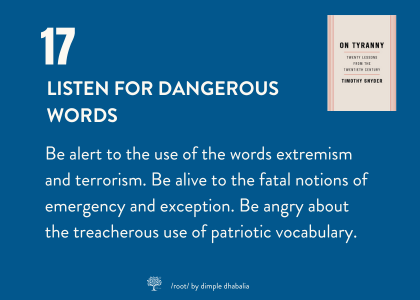
Modern authoritarian regimes use laws on extremism to punish those who criticize their policies. In this way the notion of extremism comes to mean virtually everything except what it is, in fact, extreme: tyranny.
- Timothy Snyder | On Tyranny | Lesson 17
In times of tyranny, the loudest cries of “patriotism” often echo alongside the silencing of dissent.
True patriotism is rooted in a commitment to justice, accountability, and the well-being of all people, not blind allegiance to a leader or government. But when the language of patriotism is reduced to slogans or litmus tests—such as unquestioning loyalty, symbolic gestures, or vilifying those who challenge the status quo—it becomes a tool for tyranny.
We see this in the calculated rhetoric that paints migrants as dangerous criminals, protestors as terrorists and agitators, and journalists as enemies. These words aren’t just descriptors; they’re political weapons designed to erode empathy and justify persecution. History teaches us that manipulation of language often comes before violence, as populations become desensitized to the suffering of those deemed “unpatriotic.”
But who gets to define what patriotism looks like? When Colin Kaepernick took a knee during the national anthem to protest police violence, he was labeled un-American by people who claimed to defend freedom. Yet today, we watch 47 and his entourage engage in Nazi-style salutes at rallies without so much as a blink from that same crowd. These are the same individuals who proudly fly the American flag and champion English-only policies while happily ordering tacos from the immigrant who runs the neighborhood food truck—someone who may love this country just as much, if not more, than they do. The selective outrage reveals a troubling truth: patriotism is too often framed by power and prejudice, not principle.
When I worked in the government, one of my most meaningful responsibilities was naturalizing military members—individuals who volunteered to serve and protect this country before they were ever granted citizenship. Administering their oath after they passed their citizenship tests was always deeply moving. It struck me how those who choose to become Americans often have a greater reverence for democracy and its promises than many who are born into it, yet take it for granted or fail to fully understand its responsibilities.
To safeguard democracy, we have to question not just the words used, but the actions behind them. Who is upholding democratic values through their deeds—defending free speech, protecting human rights, and fostering inclusive communities? And who uses patriotic language to mask authoritarian practices? The disconnect between rhetoric and reality is stark when policies targeting historically underserved groups are couched in terms of “national security” or “law and order.” If patriotism demands complicity in oppression, then it’s not patriotism—it’s propaganda.
Listening critically for dangerous words requires courage and vigilance. It demands that we reject hollow displays of patriotism and instead reclaim it as a commitment to justice, care, and collective liberation. True patriotism is not found in chants or salutes but in the daily work of protecting democracy from those who would hollow it out. In this moment, it’s not just the words we have to scrutinize, but the systems and actions they’re designed to disguise—and the courage we need to dismantle them.
check out other essays in this series . . .