
reclamation through righteous disobedience
/rōot/ awakenings post # 18 - on compliance, defiance, and the stories we carry
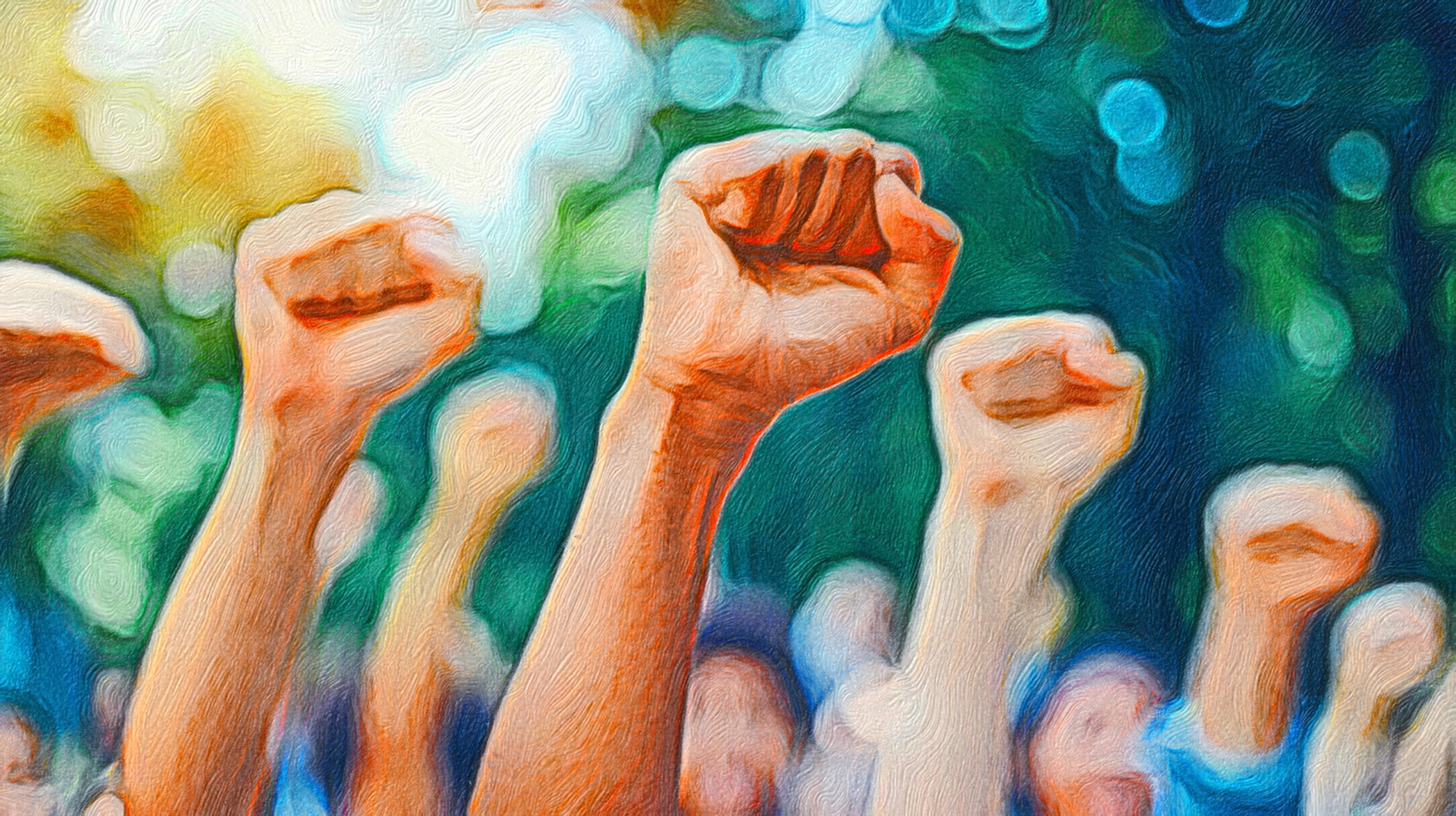
Since completing my 20-day project inspired by On Tyranny by Timothy Snyder, I’ve found myself returning again and again to Lesson 1: Do not obey in advance.
In a moment where law firms, universities, and even elected officials capitulate to the regime, I’ve been thinking deeply about what drives that obedience. Why do some institutions fold in the face of pressure, while others take a stand? Why do some people summon the moral courage to be defiant in the face of threats and harm, while others choose to comply?
It’s a question that keeps coming up for me as the stakes get higher and the regime escalates its fear tactics—people being snatched off the streets without warning, phones searched at the border (even for U.S. citizens), protests criminalized, surveillance normalized—the space for dissent feels smaller, riskier, more fragile by the day. The message is clear: stay in line, stay afraid, stay quiet.
And yet, people are still showing up.
Some lean deeper into resistance, becoming more visible as they make their voices louder and put their bodies on the front lines. Others freeze. Some comply, whether out of fear, exhaustion, or a quiet belief that resistance is futile. And I keep circling this question: What is it that makes one person push back while another backs down? Why does defiance feel instinctive for some—and terrifying for others?
It’s tempting to believe the answer lies in courage or conviction—or even just personality. But the truth is far more layered, more embodied—more human.
Long before 45/47 came into power, our lives were already shaped by stories we didn’t choose. Stories written by colonizers, upheld by white supremacy, patriarchy, capitalism, imperialism, and caste.
Their narratives weren’t born from our communities, our wisdom, or our cultures. They were imposed on us—through forced assimilation, systemic violence, institutional indoctrination, and generational trauma. They were embedded in our families, religions, school systems, media, and governance long before we had the language to name them.
For generations, their stories about worthiness dictated who could hold power, who was allowed to feel, speak, grieve, lead—and who had to stay small to survive. They wrote these stories as a way to control our bodies, our choices, our identities, and our beliefs about our worthiness for love and belonging. They told us who was considered worthy of safety, and who was expected to endure. They defined what emotions were acceptable, what kinds of people were rewarded, and what we’d be expected to sacrifice on their altar of assimilation—compliance, invisibility, perfection—in order to be seen as “good.”
But these stories don’t just live in their whitewashed history books—they live in our bodies.
As Sunita Sah writes in her book Defy, from a young age we’re conditioned to associate obedience with virtue. Compliance earns us praise, protection, and acceptance. Defiance, on the other hand, becomes linked to punishment, exclusion, and shame. This isn’t just theoretical—it’s physiological. Over time, these lessons shape our nervous systems. They teach our bodies that staying in line is safe, and that pushing back—even when something is deeply wrong—can feel like danger.
And for many of us, especially those raised in historically underserved or marginalized communities, or as children of immigrants, that sense of danger is visceral. We were taught, directly or indirectly, that survival often depends on staying quiet. That to challenge authority is to risk everything: your job, your reputation, your safety, your family’s future. That fitting in, even at the risk of suppressing pieces of ourselves, is the price for sitting at the table.
What they didn’t tell us was that even if we made it to the table, the price we paid didn’t include the thing we crave most as humans: belonging.
When we find ourselves in a moment like this one—when the stakes rise day by day, and the regime works overtime to manufacture fear—our reactions aren’t just about what’s happening now. They’re about everything we’ve been taught to believe about ourselves, our safety, and our worth.
Some of us fight. Some flee. Some freeze. Some comply. Not because we don’t care, but because this is how we’ve been conditioned to survive.
And that conditioning doesn’t just live in the mind. It lives in the body.
Which is why, in moments of moral conflict—when injustice demands a response—some of us may find ourselves immobilized. The voice inside says, speak up, take action, do something—anything—but the body contracts. Our heart races. Our breath becomes shallow. Our nervous system floods with remembered warnings: This isn’t safe. This is how you lose everything. Stay quiet. Stay small. Stay invisible.
For some, refusing to obey is clear and conscious. For others, resistance lives in the body—a slow, shaking, sacred undoing of everything we’ve been taught.
And yet, others move. They speak. They refuse. Not because they’re stronger, better, or braver—but because their nervous systems were shaped by different stories. Or because they’ve had the space, the time, or the privilege to unlearn and rewire what their body once believed was true. Or because the risk of silence feels more unbearable than the risk of defiance.
Resistance isn’t one-size-fits-all. It’s not always a bullhorn or a protest sign. It doesn’t have to be public or loud to be meaningful. Sometimes resistance looks like refusing to follow an unethical order at work. Sometimes it’s sharing truth in a meeting that wasn’t built for it. Sometimes it’s resting when the system demands your exhaustion. Sometimes it’s refusing to harden in the face of grief. Sometimes it’s organizing. Sometimes it’s calling your representatives. Sometimes it’s creating art. Sometimes it’s holding joy. Sometimes it’s holding another human.
This is why comparing our reactions—our capacity for protest, for action, for visibility—misses the point entirely.
Resistance is anything that allows us to stand up, take up space, and be who we are without apology. It’s showing up—in the ways your body, mind, and spirit can handle—with clarity, with care, with whatever resources you have in that moment.
How you resist is a choice. Not a moral grading system.
While BIPOC, LGBTQ+, and other marginalized communities have carried the weight of these stories for generations, it feels like a collective remembering is taking place—an acknowledgment that these narratives were never ours to begin with.
In a world that rewards obedience to harmful systems, every act of embodied defiance is an act of righteous disobedience—and a step toward reclamation.
And it’s this possibility of reclamation that allows me to stay hopeful about what we’re witnessing in this moment. Deep within the cries of fear, disorientation, and grief, I hear the quiet whispers of something better trying to be born out of our collective pain.
We are coming to reclaim our bodies, our stories, our spirit—our humanity. And here, we have an opportunity to begin again, together, to write new stories—rooted in dignity, agency, truth, and our shared humanity.
And none of us is meant to do this alone.
This is where community becomes not just a comfort, but a form of protection—and a source of sustainability. When we’re connected—when we feel seen, held, and reminded that we’re not carrying the weight of this moment alone—we can move from fear to action with greater ease.
Sustainable resistance requires co-regulation. It requires sharing strategies, stories, and strength. In community, we remind each other that resistance isn’t just about endurance—it’s about relationship. It’s about collective care, shared courage, and contagious hope.
In a regime that wants us to suffer through isolation, othering, and control, remembering that we belong to each other is a revolutionary act.
a compassionate reframe
If you’ve found yourself frozen, uncertain, or overwhelmed by fear in the face of injustice, it doesn’t mean you’re broken. It doesn’t mean you don’t care. It doesn’t mean you’re not brave.
It means your body remembers.
It remembers what it was taught about safety, belonging, and worthiness. It remembers what it’s learned—through culture, family, systems, and survival—about the cost of being “too visible,” “too angry,” or “too much.”
You’re not failing at resistance. You’re navigating it through layers of generational and embodied conditioning. And the fact that you are still here, still asking how to show up, still yearning for something better—that is resistance.
Let that be enough for today.
reflection prompts
As we navigate fear, embodiment, and the stories we’ve inherited about safety and survival, I invite you to pause and reflect:
- What were you taught—explicitly or implicitly—about obedience, defiance, and what it means to be “good”?
- When you think about resistance, what images or actions come to mind? Where do those ideas come from?
- What has your body learned to associate with danger? With safety? With belonging?
- What stories have you inherited that no longer serve you—and what new stories are you ready to write?
- Who are the people or communities that help you feel grounded, seen, and brave enough to resist? How can you connect or reconnect with them?
one final thought
The stories we’ve inherited may not be ours, but the ones we write now are. Even in the shadow of fear, even when systems feel immovable, we are still choosing—together—to reclaim what was never meant to be lost.
Your resistance doesn’t need to be loud or perfect to matter.
It just needs to be real.
Rooted.
Yours.
And when you can’t carry it alone, remember: you were never meant to.
Written by

subscribe
subscribe to receive new pieces as they're written






Member discussion