the violence of our silence
On Tyranny - Lesson 20
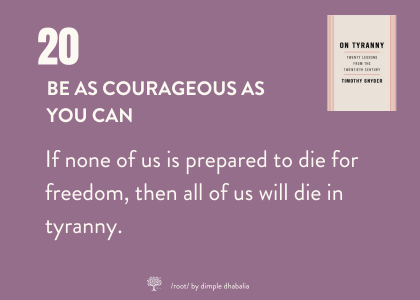
If none of us is prepared to die for freedom, then all of us will die under tyranny.
- Timothy Snyder | On Tyranny | Lesson 20
In moments of encroaching authoritarianism, when the ground beneath us feels increasingly unstable, the call to courage becomes not just moral—it becomes essential. Fascism feeds on fear, thrives on isolation, and multiplies through silence.
Under 47’s administration, we’re witnessing not the abstract threat of tyranny, but its terrifying embodiment: Venezuelan migrants with tattoos, including American citizens and non-criminals, renditioned into a jungle labor camp in El Salvador; university activists snatched off the streets for speaking out in support of Palestine while their institutions remain silent or complicit; executive orders used to criminalize dissent; and staggering governmental incompetence—air traffic chaos, nuclear oversight failures, and the leaking of classified data via unsecured text messages—placing all of us at risk. These aren’t disconnected failures. They’re coordinated tactics designed to intimidate and destabilize. They’re meant to make us afraid.
And yet, precisely because the fear is real, courage becomes even more necessary.
Courage does not mean the absence of fear; it means acting in spite of it. We ask soldiers to die in the name of freedom every single day. That’s the social contract we’ve long upheld. And now, the question we must ask ourselves is this: are we willing to do the same?
It’s a big ask—one that’s terrifying, especially when the threats are no longer distant or hypothetical, but personal. But the alternative—constantly censoring ourselves, looking over our shoulders, second-guessing who we can trust—is far more horrifying. That kind of fear seeps into our bodies, alters us on a cellular level, and becomes the raw material of generational trauma. It is a quiet kind of violence that unfolds in the absence of bombs but leaves no less destruction in its wake.
This is why moral courage matters. One of my favorite examples is from Ted Lasso, where the team collectively covers their sponsor’s name on their kits to protest the company’s unethical practices. Had only one or two players acted alone, they might’ve been punished or silenced. But together, they became impossible to ignore. That scene offers a blueprint: real change happens when people organize and act in solidarity. Courage becomes less risky—and more powerful—when it’s shared.
History teaches us that fascism doesn’t fade on its own. It must be confronted by ordinary people who choose to resist, again and again. Courage in this context isn’t always about protest or public acts of defiance; sometimes it’s as simple and sacred as refusing to dehumanize others, as choosing to speak the truth when lies are more convenient, or as showing up for someone when it would be easier to look away. These small acts, when multiplied across communities, become a force capable of breaking systems designed to extract, isolate, and control.
It’s imperative for us to be as courageous as we can—not with recklessness, but with clarity, with community, and with conviction. This is the start of a long fight, and we won’t succeed by waiting for someone else to go first. Freedom from tyranny comes when we choose each other, again and again. By caring fiercely. By standing up and speaking out, even when our voices shake.
Because courage isn’t just a shield—it’s a seed. And when we plant it in community, it becomes the foundation of something far stronger than fear: it becomes the beginning of collective liberation.
check out other essays in this series . . .