
when the alarm bells go silent
the /rōoted/ leader # 19 - on hypernormalization, dissonance, and the quiet revolution of staying human
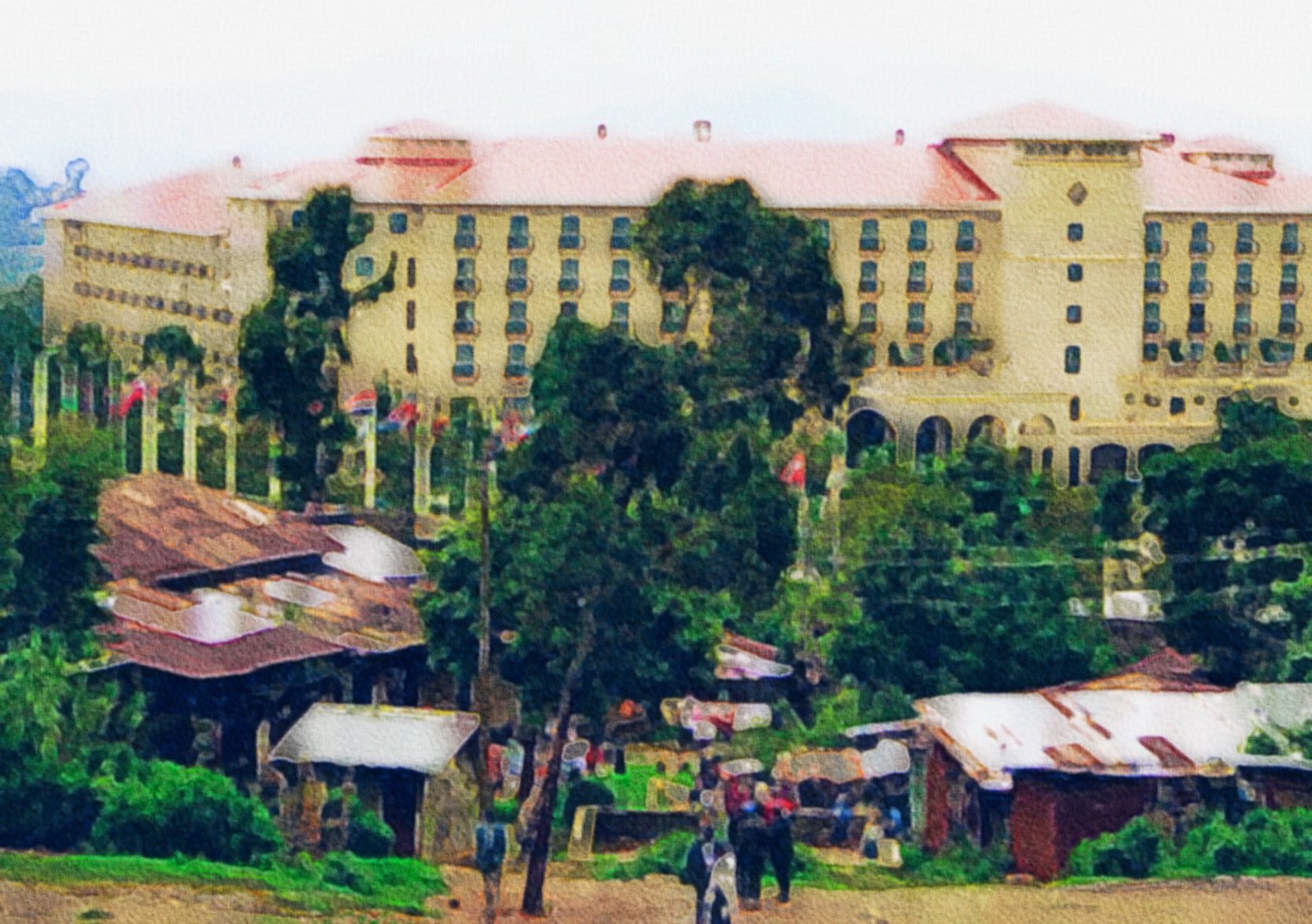
In 2006, I hiked up a hilly street in Addis Ababa, Ethiopia, camera in hand, to capture an image that has stayed with me for years.
Through my viewfinder, I framed a palatial hotel — gleaming windows, Juliet balconies, and manicured grounds — surrounded by a sea of corrugated metal roofs and line-hung laundry. I titled the photo revolution waiting to happen.
It was my first overseas assignment to process refugee resettlement cases, and the palatial hotel was where my team and I were staying. For days, I'd been plagued by a sense of guilt I couldn't fully understand. During the day, I sat across from people who had fled unimaginable violence and lost everything, whose stories would reshape my understanding of trauma and human resilience. At night, I returned to my large hotel room with its king size bed and flat screen TV where I slept soundly, and where, in the morning, a butler delivered my coffee in delicate teacups as I stared down at the city from a place of privilege I couldn't reconcile.
But then something shifted.
My colleagues and I fell into a rhythm. During the day, we absorbed the weight of human suffering in sterile interview rooms. In the evenings, our shared van passed through ornate wrought-iron gates — the kind that guard mansions and provide a false sense of safety — crossing a literal threshold from dusty roads and visible poverty to manicured lawns and quiet luxury. What was initially jarring became routine. We ordered drinks on the patio, laughed over shared meals, and planned our weekend excursions. In a matter of days, what once felt intolerable, suddenly didn’t.
I didn't have a word for what was happening at the time. But I do now.
It's called hypernormalization.
Hypernormalization is what happens when we're suspended in a kind of liminal space — between devastation and routine — where circumstances become so surreal, so chaotic, so far outside the bounds of what we're equipped to process, that our minds start to normalize the abnormal as a way to survive. It's a story we tell ourselves to keep functioning when reality becomes too much to bear.
It doesn’t happen all at once. At first, there’s shock — our bodies flood with cortisol, our mind races, our nervous system prepares to fight or flee. But when the injustice doesn’t stop and the chaos plays on a loop in the backdrop of everyday life, our system begins to adapt. The alarm bells go silent, and without realizing it, we begin to adjust to a world that should never feel normal.
Lately, this strange dissonance has been coming up in conversations with friends, clients, and colleagues. A friend recently shared how, one minute, she was reading about genocide and families torn apart by immigration raids; the next, she found herself scrolling through a list of the best weekend brunch spots and laughing at pet videos. This constant toggle between catastrophe and normalcy creates a kind of whiplash — one that quietly erodes our sense of clarity and emotional coherence.
And while we've inherited a culture that expects us to compartmentalize, especially in the workplace, that expectation is rooted in the legacy of industrialization, where the pursuit of standardization and efficiency led to people being treated as little more than “resources” there to get the job done. That legacy endures in today’s institutions, where betrayal often accelerates hypernormalization. We are witnessing this every day as organizations abandon their stated values, ask staff to carry out harmful policies, prioritize profit or productivity over people, or look away from or ignore suffering under the guise of efficiency. In return, we're expected to compartmentalize our emotions, suppress our moral distress, and stay silent in order to keep our jobs.
But the truth is, we’re not living in an episode of Severance. We are whole human beings who don't leave a piece of ourselves at the door when we move between personal and professional spaces. Our bodies continue to process the pain of what we’re witnessing and experiencing long after our minds have moved on.
Despite its name, hypernormalization doesn’t actually make these circumstances normal — it just teaches us how to survive inside what historically would have been deemed as unthinkable.
Social media has only made the situation worse. Algorithms, designed to hijack our attention, serve up a relentless stream of heartbreak and trauma, keeping our nervous systems in a constant state of alert. Before our minds have a chance to process one crisis, another appears. Our bodies are still metabolizing yesterday’s pain while our brains are already moving on to the next thing.
We carry what we witness, whether or not we speak it aloud. And for those of us in helping professions — social workers, aid workers, therapists, attorneys, healthcare providers, activists — that carrying becomes occupational. We absorb story after story of harm and injustice until our nervous systems, which were never meant to stay activated for this long, become chronically overwhelmed. Hypernormalization becomes our mind’s attempt to create distance from a pain that threatens to consume us.
And the cost of pretending otherwise is a soul-deep exhaustion that we're only now beginning to acknowledge.
The connection between hypernormalization and institutional betrayal isn't new. For BIPOC, LGBTQIA+, disabled, and other historically marginalized communities, this emotional and psychological dissonance has long been a default setting because the systems we were told to trust were never built to protect us in the first place. The double-consciousness, the code-switching, the hypervigilance, and the constant calculations of safety and survival aren’t new, they’re survival strategies that many communities have carried for generations to survive in systems that were designed to extract, erase, and dehumanize.
What’s different now is that, for those with positional or racial privilege, the curtain has finally lifted and the reality so many have long lived with is becoming impossible to ignore. I've noticed it in myself in the way I flinch less at the headlines. The way I feel a little more resigned each time I hear about another policy meant to dehumanize. The way I sometimes avoid the news altogether, not because I don't care, but because I care too much. I catch myself numbing, zoning out, going through the motions.
In those moments when I feel down and despondent, I try to remind myself that normalizing injustice isn't the same as healing from it. And numbness isn't a measure of strength — it's a measure of just how much our bodies are holding, and how few places there are to lay our pain down.
The current political moment makes this all the more urgent.
Since the start of his second term, 47 has ushered in a level of institutional dismantling that once felt unimaginable in this country. The erosion of federal checks and balances, the decimation of the civil service, the open consolidation of power with the help of billionaire tech moguls. The Centers for Disease Control. USAID. The State Department. US Citizenship and Immigration Services. These aren’t just bureaucracies — they're public lifelines that are being hollowed out in real time, with the effects crashing across the globe like tsunami waves.
Add to that the backdrop of climate collapse, global conflict, generative AI, systemic grief, economic instability, mass job loss, and the ongoing impacts of COVID, and it’s no wonder so many of us feel suspended between terror and fatigue. This is what it means to witness the unraveling of a society, not as something studied in a history class, but now, in real time.
I’m not sure if this will provide comfort to anyone, but we don’t shut down because we feel nothing. We shut down because we feel too much. The world keeps trying to convince us that compartmentalization is resilience. But we aren’t machines. We were never meant to endure this much and feel nothing. We aren’t broken for feeling broken by it.
Maybe the revolution I thought I saw in the photo I took in Ethiopia all those years ago wasn’t just about protest signs or public upheaval. Maybe it’s slower than that. More internal. Maybe the real revolution is how we hold the weight of what’s happening without letting it hollow us out. Maybe it’s choosing to feel our pain instead of numbing ourselves to it. Maybe it’s about speaking up when silence feels safer. Maybe it’s about caring differently — not less. Maybe it’s about staying human in systems that keep asking us to disconnect from our humanity.
This is what sacred resistance looks like. Not loud or performative, but quiet, rooted, and deeply human — the act of staying present to pain without letting it consume us.
Perhaps the quietest, most revolutionary thing we can do right now is acknowledge what we carry, and refuse to call it normal.
tell me my story is now available as an audiobook!
I’m honored to share that the audiobook version of Tell Me My Story: Challenging the Narrative of Service Before Self is now available. If you or someone you love has struggled with what it means to serve without sacrificing your well-being, this book is for you. Part memoir, part manifesto, and 100% my heart. If you listen and find something that resonates, please drop me a line, or better yet, please consider leaving a review. Every review helps indie authors like me reach more people. You can read more about my experience with recording the book here and find links to get the audiobook below.
Written by

subscribe
subscribe to receive new pieces as they're written






Member discussion