
scorched earth as a story of survival, not submission
/rōot/ awakenings post # 14 - on power, control, and rising from the ashes
Last week, overwhelmed by yet another onslaught of headlines describing the cruel and reckless actions of a regime hellbent on consolidating power—a single term popped into my mind: scorched earth.
I first learned about scorched earth campaigns when I interviewed asylum seekers and refugees from Guatemala. They described how, in the late 1980s, their government systematically burned villages, crops, and entire communities to the ground—an attempt to erase the Maya people, to ensure there was nothing left for them to return to. But this strategy wasn’t unique to the Guatemalans. Settlers used it against Indigenous populations in the U.S., it was deployed in World War II, the Spanish Civil War, and in genocides around the world—from Darfur to most recently, Gaza. While historically considered a military strategy, at its core, scorched earth is about power and control.
And that’s exactly what we’re witnessing here in the U.S. right now.
The current regime may not be setting fire to fields, but they are burning down everything they believe stands in their path to absolute control—rights, protections, institutions, social safety nets. Their goal is the same as any scorched earth campaign: to leave nothing behind. To ensure that when they’re done, there’s no ground left to rebuild from, no foundation for those who would resist them, no hope of return.
No matter how much the current regime wants it to be, destruction is not disappearance. History—and nature—have shown us this time and time again.
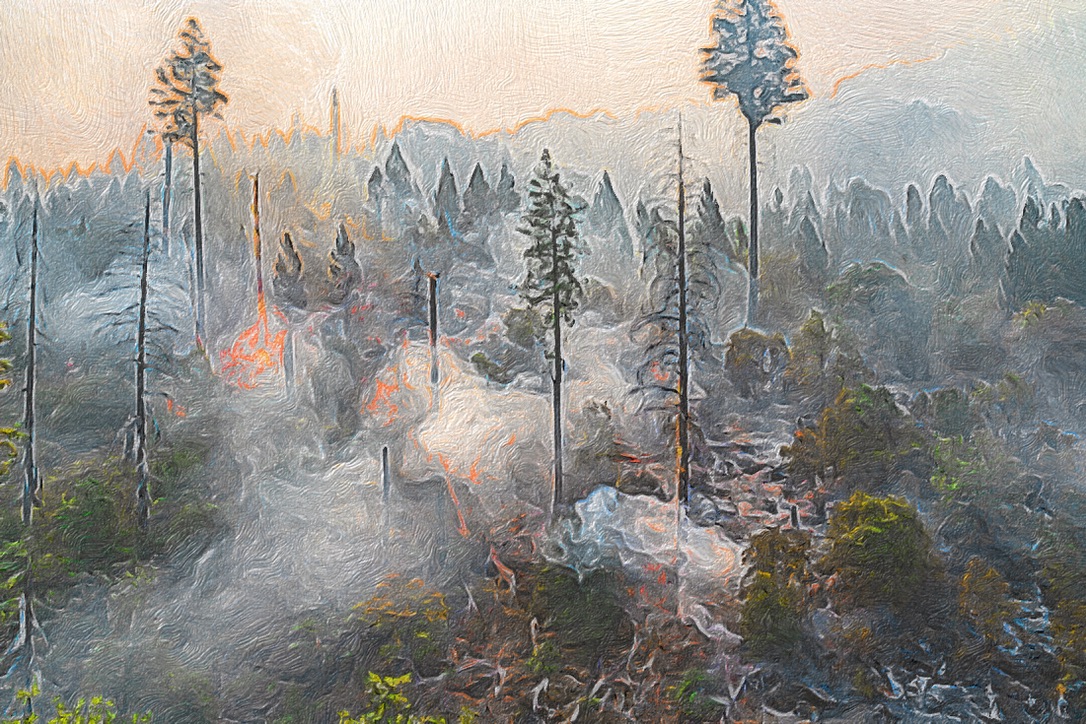
Last year, while visiting the Redwoods in California, I came across a clearing where hundreds of trees had burned down. As I stood on the charred land, I tried to imagine what it must have been like—a wildfire raging through the trees, the inferno devouring bark and trunk as it climbed higher, tendrils of flames curling around branches, engulfing the canopy. Thick plumes of smoke reaching toward the sky, heavy and unrelenting, leaving behind devastation—a post-apocalyptic landscape of ash-covered ground, the skeletal remains of once-towering trees, and silence.
At first glance, it could be mistaken for defeat.
It would be easy to believe the forest had been destroyed, that the damage was final. But then, at the foot of a thick trunk, I saw bright pops of green and yellow emerging from the earth. Beneath the surface, a quiet battle was already underway.
Seeds that had been dormant for years cracked open in the heat, finally given the conditions they needed to grow. Deep underground, roots stretched toward each other in beautiful acts of collective care—weaving unseen connections, sending signals, sharing nutrients, whispering instructions for recovery. Some trees, though scorched, still stood—holding space, sheltering the new growth that would rise in their place.
The forest wasn’t gone. It was fighting in ways I couldn’t see.
Right now, it feels like we’re living inside a firestorm. The world as we’ve known it is burning in ways that feel impossible to contain—power wielded recklessly, rights stripped away, cruelty unleashed without consequence. The regime’s actions are designed to break us down, to make us believe that resistance is futile, that surrender is our only option.
What often gets overlooked in the chaos they create is that their destruction isn’t absolute. Even the forests fight to rise after fire. And so must we.
The same forces that try to reduce us to nothing always underestimate one thing: our resilience. The Civil Rights Movement is proof that even when systems try to erase people, the fight doesn’t disappear—it evolves and adapts. Segregation, voter suppression, racial terror, and even literal acts of destruction—like the burning of Black Wall Street in Tulsa—were meant to keep Black Americans oppressed, to destroy their communities beyond repair. But they resisted. And their fight reshaped laws, institutions, and culture, bringing forth new generations of activists who continue to demand justice today. Even now, as civil rights come under attack again, the foundation laid by past generations fuels the resistance of today. What was built once can be rebuilt—stronger than before.
History has shown us that scorched earth strategies—while painful and destructive—rarely achieve their ultimate goal of absolute control. Time and again, in places where governments have tried to erase people—to burn down not just their homes, but their hope, their culture, their resistance—something else has emerged. A unity of purpose as people rise from the ashes. They organize, they reclaim, and they build something new. Something stronger. Something they were never meant to have.
Like the trees, we have the capacity to send signals of support, to support each other by practicing collective care. We can strengthen our roots beneath the surface—organizing, protecting, and ensuring that what they try to destroy does not die, but transforms.
We can nurture the foundation of something bigger than this moment, something that will outlast even the most devastating fires.
a compassionate reframe
Scorched earth is meant to erase. It is designed to make us believe there is nothing left to fight for, that resistance is futile, that we should give in to the destruction. But even in the midst of ruin, we still have choices. Survival isn’t about submission; it’s about choosing where to place our energy, where to root ourselves in the chaos. It invites us to surrender—not to those in power, but to the moment itself. To recognize what is beyond our control and to focus on what we can still nurture, still protect, still grow.
Surrendering to the moment doesn’t mean giving up. It’s the practice of rooting ourselves in what remains—holding on to the things they cannot take: our connections, our communities, our capacity to care. It’s the choice to keep showing up, even when everything feels uncertain. The refusal to be erased.
Because simply being here, continuing to exist in the face of those who seek to oppress us, is resistance in itself.
reflection prompts
As we begin sifting through the ashes of the current destruction, I invite you to reflect on the following:
- Where in your life have you mistaken destruction for the end, when it was really a new beginning?
- Where in your life are you quietly resisting—holding on, refusing to disappear?
- Who or what are the unseen forces that have helped keep you standing in difficult times?
- How can you remind yourself that healing and regeneration are happening, even when you can’t see them yet?
one final thought
Nature reminds us that even in destruction, when it looks like all is lost, life continues. Something deeper is always at work. Survival is not submission. Destruction is not defeat. Authoritarian regimes carry out scorched earth campaigns hoping we will be crushed beneath the weight of it all—that we will submit, stay silent, and disappear. But the forests teach us to tell a different story.
A story of resilience. A story of connection. A story of care.
A story in which we’re still here. Still fighting. And still hopeful, always.
Written by

subscribe
subscribe to receive new pieces as they're written






Member discussion