
welcome to rōot
a living journal mapping the moral, ethical, and spiritual foundations of our shared humanity + our duty of care to each other

I started this publication the week after the 2024 election.
I didn't know exactly what I was building. I only knew I needed a place to think out loud — to sit with the rage that had been rising in me for months and figure out what it was asking of me. As a brown woman and the daughter of immigrants, I've spent a lifetime navigating systems that were never designed to honor the full depth and breadth of my humanity. But something about that moment felt different. The cruelty was no longer hidden. It was out in the open, sanctioned, and celebrated. And the ground beneath so many of us simply gave way.
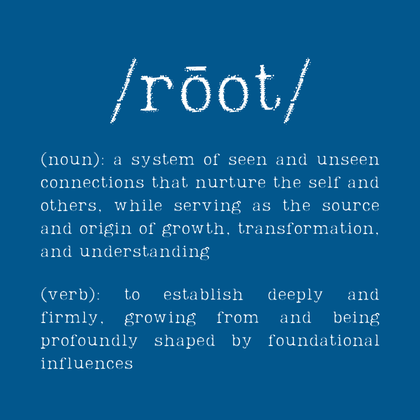
I decided to call this publication rōot because the word itself holds a duality I find honest: roots as a source of nourishment and connection and also as the origins of our pain and suffering. In nature, disturbances—whether storms, fires, or floods—disrupt landscapes, opening space for both destruction and renewal. Like the maple tree in my yard shedding its fiery leaves, these disturbances remind us that what appears as loss is often just one chapter in a much longer story. Similarly, this moment in our collective history is not the entire story; even in the face of destruction, we have the agency to choose what to nourish, what to prune, and what to uproot entirely to create space for something new to grow long after we're gone.
Since publishing my first essay in 2024, I've come to understand that this moment we're living through isn't an anomaly, but a seasonal convergence. We're living inside what is increasingly being named polycrisis: overlapping, mutually amplifying crises that don't leave us time to recover between them. Wars. Genocides. Climate degradation. Political instability. Institutional betrayal. Collective grief. The accumulating weight of bearing witness to so much suffering, both within and outside of existing systems, is taking a toll on individuals across mission-driven sectors.
What I've watched happen to people inside those systems — and what happened to me — has a name: moral injury. It's the conflict we experience when the institutions we dedicated our lives to betray not just us, but the people we were meant to serve, and expect us to act against our own values — and it rarely travels alone. Institutional betrayal, vicarious trauma, and collective grief often arrive alongside it.
This conflict and its companions were a significant part of my nearly two decades working on asylum and refugee operations for the US government. They're what I've been writing and speaking about since I left. They shaped the lived experience I bring to my work with individuals and organizations. And they're what I've taken into rooms at the International Centre for Moral Injury's annual conference at Durham University, the Beyond Aid Summit, and the Yale Women's Mental Health Conference — among others.
I've also been spending time with the trees.
In 2024, I found myself in a plant-based storytelling class that changed how I understand the world and my place in it. I came in with a surface-level understanding of root systems and mycelial networks. I left with something much more embodied: an understanding of the whole living architecture linking roots, stems, leaves, and canopy with spirituality, ethics, and care. Since then, spiritual ecology has been central to all my work — because it places us within living, interdependent systems rather than apart from them. And that matters, because moral injury at its core is a rupture in relationship — with ourselves, with our values, with our communities, and with the work we've dedicated our lives to.
What nature shows us is that when a tree is injured or uprooted, it sends messages of distress through the air and the roots — and the ecosystem responds. From the highest canopies to the mycelial root networks, the surrounding trees provide nourishment and stability until the tree is strong enough to stand on its own again. Nature regularly creates the conditions for the whole forest to survive the storm — together.
That is what I am trying to do here — create the conditions for us to survive our storms — together.
rōot brings together two bodies of work I used to keep separate: the spiritual ecology, creative practice, and collective imagination that gave this publication its name, and the story-healing, moral courage, and rooted leadership work I developed through /the rōoted leader/. I kept them apart for a long time because we've been conditioned to believe that spirituality doesn't belong in professional spaces. That the part of me who finds awe in the natural world and honors her ancestors should be kept private in order for the part of me who facilitates and writes and speaks to flourish and "succeed."
What I've come to realize is that simply isn't true. Compartmentalization is a tool of industrialization, capitalism, and white supremacy that I'm no longer willing to perpetuate. I don't want to write from that division.
So this is the integrated version. The whole version.
Think of this as a living journal about leading and being whole human beings while staying present to the pain and possibility found in complex, often contradictory spaces.
If you've found your way here, I hope you'll find what you need to stay.
with gratitude,
dimple
Written by

subscribe
subscribe to receive new pieces as they're written



Member discussion